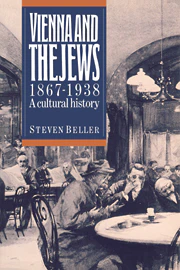
Vienna and the Jews, 1867–1938
This book studies the role played by Jews in the explosion of cultural innovation in Vienna at the turn of the century, which had its roots in the years following the Ausgleich of 1867 and its demise in the sweeping events of the 1930s. Dr Beller shows that, among the personnel of leading society, Jews were predominant throughout most of Viennese modern high culture. Thus any attempts to dismiss the 'Jewish aspect' of the intelligentsia are necessarily refuted. The book then goes on to explain this 'Jewish aspect', disclaiming any unitary, static model, but adopting an historical approach which sees the 'Jewishness' of Viennese modern culture as a result of the specific Jewish backgrounds of most the of leading cultural figures and their own reactions to being Jewish. The culture of fin-de-siècle Vienna, it is claimed finally, was born out of the vivid encounter between the Jewish background and the Viennese context.
Product Information
Product Information
Shipping & Returns
Shipping & Returns
Vienna and the Jews, 1867–1938
Vienna and the Jews, 1867–1938
This book studies the role played by Jews in the explosion of cultural innovation in Vienna at the turn of the century, which had its roots in the years following the Ausgleich of 1867 and its demise in the sweeping events of the 1930s. Dr Beller shows that, among the personnel of leading society, Jews were predominant throughout most of Viennese modern high culture. Thus any attempts to dismiss the 'Jewish aspect' of the intelligentsia are necessarily refuted. The book then goes on to explain this 'Jewish aspect', disclaiming any unitary, static model, but adopting an historical approach which sees the 'Jewishness' of Viennese modern culture as a result of the specific Jewish backgrounds of most the of leading cultural figures and their own reactions to being Jewish. The culture of fin-de-siècle Vienna, it is claimed finally, was born out of the vivid encounter between the Jewish background and the Viennese context.
Original: $40.46
-70%$40.46
$12.14Product Information
Product Information
Shipping & Returns
Shipping & Returns
Description
This book studies the role played by Jews in the explosion of cultural innovation in Vienna at the turn of the century, which had its roots in the years following the Ausgleich of 1867 and its demise in the sweeping events of the 1930s. Dr Beller shows that, among the personnel of leading society, Jews were predominant throughout most of Viennese modern high culture. Thus any attempts to dismiss the 'Jewish aspect' of the intelligentsia are necessarily refuted. The book then goes on to explain this 'Jewish aspect', disclaiming any unitary, static model, but adopting an historical approach which sees the 'Jewishness' of Viennese modern culture as a result of the specific Jewish backgrounds of most the of leading cultural figures and their own reactions to being Jewish. The culture of fin-de-siècle Vienna, it is claimed finally, was born out of the vivid encounter between the Jewish background and the Viennese context.