The Simulation of Surveillance
This compelling book, first published in 1996, is an exploration of the imaginary of perceptual control technologies at the beginning of the twenty-first century. William Bogard constructs a 'social science fiction' of how the revolution in simulation technology reconfigures and intensifies the role of surveillance in war, work, sexuality and private life, enabling forms of control which hyper realise our experience of time, space, agency and society itself. His is a critique of the imaginary in which control breaks free of its prior limits, an imaginary of unmediated perception with effects everywhere in fantastic systems for the relentless conversion of objects, events and people into information.
Product Information
Product Information
Shipping & Returns
Shipping & Returns
The Simulation of Surveillance
The Simulation of Surveillance
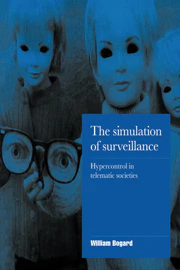
This compelling book, first published in 1996, is an exploration of the imaginary of perceptual control technologies at the beginning of the twenty-first century. William Bogard constructs a 'social science fiction' of how the revolution in simulation technology reconfigures and intensifies the role of surveillance in war, work, sexuality and private life, enabling forms of control which hyper realise our experience of time, space, agency and society itself. His is a critique of the imaginary in which control breaks free of its prior limits, an imaginary of unmediated perception with effects everywhere in fantastic systems for the relentless conversion of objects, events and people into information.
Original: $53.96
-70%$53.96
$16.19Product Information
Product Information
Shipping & Returns
Shipping & Returns
Description
This compelling book, first published in 1996, is an exploration of the imaginary of perceptual control technologies at the beginning of the twenty-first century. William Bogard constructs a 'social science fiction' of how the revolution in simulation technology reconfigures and intensifies the role of surveillance in war, work, sexuality and private life, enabling forms of control which hyper realise our experience of time, space, agency and society itself. His is a critique of the imaginary in which control breaks free of its prior limits, an imaginary of unmediated perception with effects everywhere in fantastic systems for the relentless conversion of objects, events and people into information.