Stare Indecisis
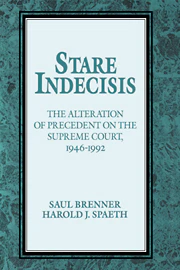
Although the concept of precedent is basic to the operation of the legal system, there has not yet been a full-length empirical study of why US Supreme Court justices have chosen to alter precedent. This book attempts to fill this gap by analyzing those decisions of the Vinson, Warren, and Burgers courts, as well as the first six terms of the Rehnquist Court - a span of 47 years (1946–1992) - which formally altered precedent. The authors summarize previous studies of precedent and the Court, assess the conference voting of justices, and compile a list of overruling and overruled cases. Additionally, the authors draw a distinction between personal and instituional stare decisis. By using the attitudinal model of Supreme Court decision making, the authors find that it is the individual justices' ideologies which explain their voting behavior.
Product Information
Product Information
Shipping & Returns
Shipping & Returns
Stare Indecisis
Stare Indecisis
Although the concept of precedent is basic to the operation of the legal system, there has not yet been a full-length empirical study of why US Supreme Court justices have chosen to alter precedent. This book attempts to fill this gap by analyzing those decisions of the Vinson, Warren, and Burgers courts, as well as the first six terms of the Rehnquist Court - a span of 47 years (1946–1992) - which formally altered precedent. The authors summarize previous studies of precedent and the Court, assess the conference voting of justices, and compile a list of overruling and overruled cases. Additionally, the authors draw a distinction between personal and instituional stare decisis. By using the attitudinal model of Supreme Court decision making, the authors find that it is the individual justices' ideologies which explain their voting behavior.
Original: $157.46
-70%$157.46
$47.24Product Information
Product Information
Shipping & Returns
Shipping & Returns
Description
Although the concept of precedent is basic to the operation of the legal system, there has not yet been a full-length empirical study of why US Supreme Court justices have chosen to alter precedent. This book attempts to fill this gap by analyzing those decisions of the Vinson, Warren, and Burgers courts, as well as the first six terms of the Rehnquist Court - a span of 47 years (1946–1992) - which formally altered precedent. The authors summarize previous studies of precedent and the Court, assess the conference voting of justices, and compile a list of overruling and overruled cases. Additionally, the authors draw a distinction between personal and instituional stare decisis. By using the attitudinal model of Supreme Court decision making, the authors find that it is the individual justices' ideologies which explain their voting behavior.