Routledge Handbook of Francophone Africa
The Routledge Handbook of Francophone Africa brings together a multidisciplinary team of international experts to reflect on the history, politics, societies, and cultures of French-speaking parts of Africa.
Consisting of approximately 35% of Africa’s territory, Francophone Africa is a shifting concept, with its roots in French and Belgian colonial rule. This handbook develops and problematizes the term, with thematic sections covering:
- Colonial and post-colonial ties between France and sub-Saharan Africa
- Belgium, Belgian colonialism and Africa
- The Maghreb
- African Francophones in France
- Francophone African literature and film
- ‘Francophone’ and ‘Anglophone’ Africa
- Beyond national boundaries and ‘colonial partners’
The chapters demonstrate the evolution of "Francophone Africa" into a multi-dimensional construct, with both a material and an imagined reality. Materially, it defines a regional territorial space that coexists with other conceptualisations of African space and borders. Conceptually, Francophone Africa constitutes a shared linguistic and cultural space within which collective memories are shared, not least through their connection to the French imperial imagination. Overall, the Handbook demonstrates that as global power structures and relations evolve, African agency is increasingly assertive in shaping French-African relations.
Bringing this important debate together into a single volume, this Handbook will be an essential resource for students and scholars interested in Francophone Africa.
Product Information
Product Information
Shipping & Returns
Shipping & Returns
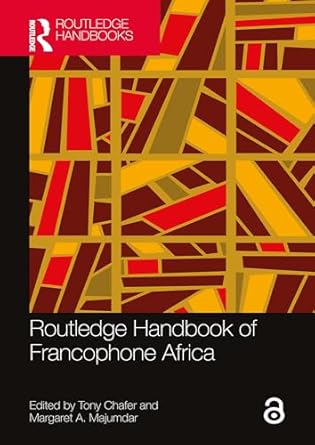
Routledge Handbook of Francophone Africa
Routledge Handbook of Francophone Africa
The Routledge Handbook of Francophone Africa brings together a multidisciplinary team of international experts to reflect on the history, politics, societies, and cultures of French-speaking parts of Africa.
Consisting of approximately 35% of Africa’s territory, Francophone Africa is a shifting concept, with its roots in French and Belgian colonial rule. This handbook develops and problematizes the term, with thematic sections covering:
- Colonial and post-colonial ties between France and sub-Saharan Africa
- Belgium, Belgian colonialism and Africa
- The Maghreb
- African Francophones in France
- Francophone African literature and film
- ‘Francophone’ and ‘Anglophone’ Africa
- Beyond national boundaries and ‘colonial partners’
The chapters demonstrate the evolution of "Francophone Africa" into a multi-dimensional construct, with both a material and an imagined reality. Materially, it defines a regional territorial space that coexists with other conceptualisations of African space and borders. Conceptually, Francophone Africa constitutes a shared linguistic and cultural space within which collective memories are shared, not least through their connection to the French imperial imagination. Overall, the Handbook demonstrates that as global power structures and relations evolve, African agency is increasingly assertive in shaping French-African relations.
Bringing this important debate together into a single volume, this Handbook will be an essential resource for students and scholars interested in Francophone Africa.
Original: $83.69
-70%$83.69
$25.11Product Information
Product Information
Shipping & Returns
Shipping & Returns
Description
The Routledge Handbook of Francophone Africa brings together a multidisciplinary team of international experts to reflect on the history, politics, societies, and cultures of French-speaking parts of Africa.
Consisting of approximately 35% of Africa’s territory, Francophone Africa is a shifting concept, with its roots in French and Belgian colonial rule. This handbook develops and problematizes the term, with thematic sections covering:
- Colonial and post-colonial ties between France and sub-Saharan Africa
- Belgium, Belgian colonialism and Africa
- The Maghreb
- African Francophones in France
- Francophone African literature and film
- ‘Francophone’ and ‘Anglophone’ Africa
- Beyond national boundaries and ‘colonial partners’
The chapters demonstrate the evolution of "Francophone Africa" into a multi-dimensional construct, with both a material and an imagined reality. Materially, it defines a regional territorial space that coexists with other conceptualisations of African space and borders. Conceptually, Francophone Africa constitutes a shared linguistic and cultural space within which collective memories are shared, not least through their connection to the French imperial imagination. Overall, the Handbook demonstrates that as global power structures and relations evolve, African agency is increasingly assertive in shaping French-African relations.
Bringing this important debate together into a single volume, this Handbook will be an essential resource for students and scholars interested in Francophone Africa.