Remus
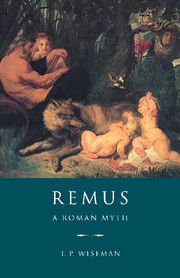
Romulus founded Rome - but why does the myth give him a twin brother Remus, who is killed at the moment of the foundation? This mysterious legend has been oddly neglected. Roman historians ignore it as irrelevant to real history; students of myth concentrate on the more glamorous mythology of Greece. In this book, Professor Wiseman provides, for the first time, a detailed analysis of all the variants of the story, and a historical explanation for its origin and development. His conclusions offer important new insights, both into the history and ideology of pre-imperial Rome and into the methods and motives of myth-creation in a non-literate society. In the richly unfamiliar Rome of Pan, Hermes and Circe the witch-goddess, where a general grows miraculous horns and prophets demand human sacrifice, Remus stands for the unequal struggle of the many against the powerful few.
Product Information
Product Information
Shipping & Returns
Shipping & Returns
Remus
Remus
Romulus founded Rome - but why does the myth give him a twin brother Remus, who is killed at the moment of the foundation? This mysterious legend has been oddly neglected. Roman historians ignore it as irrelevant to real history; students of myth concentrate on the more glamorous mythology of Greece. In this book, Professor Wiseman provides, for the first time, a detailed analysis of all the variants of the story, and a historical explanation for its origin and development. His conclusions offer important new insights, both into the history and ideology of pre-imperial Rome and into the methods and motives of myth-creation in a non-literate society. In the richly unfamiliar Rome of Pan, Hermes and Circe the witch-goddess, where a general grows miraculous horns and prophets demand human sacrifice, Remus stands for the unequal struggle of the many against the powerful few.
Original: $70.16
-70%$70.16
$21.05Product Information
Product Information
Shipping & Returns
Shipping & Returns
Description
Romulus founded Rome - but why does the myth give him a twin brother Remus, who is killed at the moment of the foundation? This mysterious legend has been oddly neglected. Roman historians ignore it as irrelevant to real history; students of myth concentrate on the more glamorous mythology of Greece. In this book, Professor Wiseman provides, for the first time, a detailed analysis of all the variants of the story, and a historical explanation for its origin and development. His conclusions offer important new insights, both into the history and ideology of pre-imperial Rome and into the methods and motives of myth-creation in a non-literate society. In the richly unfamiliar Rome of Pan, Hermes and Circe the witch-goddess, where a general grows miraculous horns and prophets demand human sacrifice, Remus stands for the unequal struggle of the many against the powerful few.