Philosophy, Philology, and Politics in Eighteenth-Century China
This book explains the general intellectual climate of the early Ch'ing period, and the political and cultural characteristics of the Ch'ing regime at the time. Professor Huang brings to life the book's central characters, Li Fu and the three great emperors - K'ang-hsi, Yung-cheng, and Chien-lung - whom he served. Although the author's main concern is to explain the contributions of Li Fu to the Lu-Wang school of Confucianism, he also gives a clearly written account of the Lu-Wang and Ch'eng-Chu schools from the twelfth century to the eighteenth. In a clear, succinct style, Huang explains the historical differences between the Ch'eng-Chu and Lu-Wang schools without sacrificing the subtleties of either. The book culminates in a discussion of the hero-emperor K'ang-hsi's appropriation of the 'Tradition of the Way' from his intellectual officials, which denied them their traditional role as moral censors and critics of the emperor's exercise of authority.
Product Information
Product Information
Shipping & Returns
Shipping & Returns
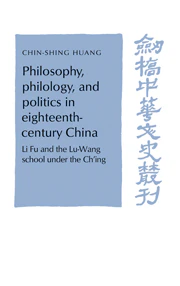
Philosophy, Philology, and Politics in Eighteenth-Century China
Philosophy, Philology, and Politics in Eighteenth-Century China
This book explains the general intellectual climate of the early Ch'ing period, and the political and cultural characteristics of the Ch'ing regime at the time. Professor Huang brings to life the book's central characters, Li Fu and the three great emperors - K'ang-hsi, Yung-cheng, and Chien-lung - whom he served. Although the author's main concern is to explain the contributions of Li Fu to the Lu-Wang school of Confucianism, he also gives a clearly written account of the Lu-Wang and Ch'eng-Chu schools from the twelfth century to the eighteenth. In a clear, succinct style, Huang explains the historical differences between the Ch'eng-Chu and Lu-Wang schools without sacrificing the subtleties of either. The book culminates in a discussion of the hero-emperor K'ang-hsi's appropriation of the 'Tradition of the Way' from his intellectual officials, which denied them their traditional role as moral censors and critics of the emperor's exercise of authority.
Product Information
Product Information
Shipping & Returns
Shipping & Returns
Description
This book explains the general intellectual climate of the early Ch'ing period, and the political and cultural characteristics of the Ch'ing regime at the time. Professor Huang brings to life the book's central characters, Li Fu and the three great emperors - K'ang-hsi, Yung-cheng, and Chien-lung - whom he served. Although the author's main concern is to explain the contributions of Li Fu to the Lu-Wang school of Confucianism, he also gives a clearly written account of the Lu-Wang and Ch'eng-Chu schools from the twelfth century to the eighteenth. In a clear, succinct style, Huang explains the historical differences between the Ch'eng-Chu and Lu-Wang schools without sacrificing the subtleties of either. The book culminates in a discussion of the hero-emperor K'ang-hsi's appropriation of the 'Tradition of the Way' from his intellectual officials, which denied them their traditional role as moral censors and critics of the emperor's exercise of authority.