Islamic State, Biopolitics and Media Governmentality
This book analyses the Islamic State’s (IS) media and governance strategy from a critical media and cultural studies perspective.
It deploys Deleuze and Guattari’s concept of assemblage and Foucault’s theories of dispositif (dispositive, apparatus) and biopower to understand the ways in which IS governed its subjects during the tenure of its so-called ‘caliphate’. This theoretical triangulation is used to situate the group as more than just a terrorist organisation, but rather as a more amorphous force with proclivities toward governance. The analysis of globally fluid and conjunctive terrorist strategies executed through media, governance and conduct, as part of and produced by IS’s dispositif, manifests in the group’s epistemology, discourse and social ontology. To analyse these processes, the book deploys a dispositif analysis of official IS administrative documents, media produced by the group’s English-language media wing (al-Hayat Media Center), and IS Twitter activity, including the use of nonhuman bots. In doing so, it seeks to reveal the resonance between IS’s media and governmental discourses, develop dispositif theory, and to argue for more context-specific formulations of biopolitics.
This book will be of much interest to students of Critical Terrorism Studies, social theory, media theory and International Relations.
Product Information
Product Information
Shipping & Returns
Shipping & Returns
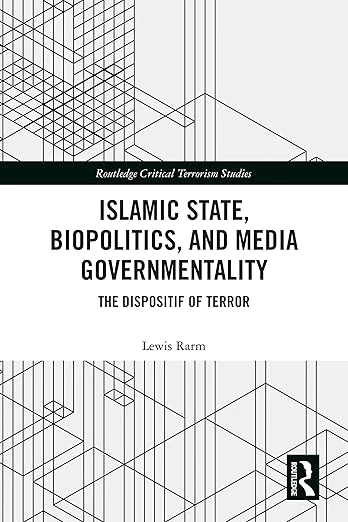
Islamic State, Biopolitics and Media Governmentality
Islamic State, Biopolitics and Media Governmentality
This book analyses the Islamic State’s (IS) media and governance strategy from a critical media and cultural studies perspective.
It deploys Deleuze and Guattari’s concept of assemblage and Foucault’s theories of dispositif (dispositive, apparatus) and biopower to understand the ways in which IS governed its subjects during the tenure of its so-called ‘caliphate’. This theoretical triangulation is used to situate the group as more than just a terrorist organisation, but rather as a more amorphous force with proclivities toward governance. The analysis of globally fluid and conjunctive terrorist strategies executed through media, governance and conduct, as part of and produced by IS’s dispositif, manifests in the group’s epistemology, discourse and social ontology. To analyse these processes, the book deploys a dispositif analysis of official IS administrative documents, media produced by the group’s English-language media wing (al-Hayat Media Center), and IS Twitter activity, including the use of nonhuman bots. In doing so, it seeks to reveal the resonance between IS’s media and governmental discourses, develop dispositif theory, and to argue for more context-specific formulations of biopolitics.
This book will be of much interest to students of Critical Terrorism Studies, social theory, media theory and International Relations.
Product Information
Product Information
Shipping & Returns
Shipping & Returns
Description
This book analyses the Islamic State’s (IS) media and governance strategy from a critical media and cultural studies perspective.
It deploys Deleuze and Guattari’s concept of assemblage and Foucault’s theories of dispositif (dispositive, apparatus) and biopower to understand the ways in which IS governed its subjects during the tenure of its so-called ‘caliphate’. This theoretical triangulation is used to situate the group as more than just a terrorist organisation, but rather as a more amorphous force with proclivities toward governance. The analysis of globally fluid and conjunctive terrorist strategies executed through media, governance and conduct, as part of and produced by IS’s dispositif, manifests in the group’s epistemology, discourse and social ontology. To analyse these processes, the book deploys a dispositif analysis of official IS administrative documents, media produced by the group’s English-language media wing (al-Hayat Media Center), and IS Twitter activity, including the use of nonhuman bots. In doing so, it seeks to reveal the resonance between IS’s media and governmental discourses, develop dispositif theory, and to argue for more context-specific formulations of biopolitics.
This book will be of much interest to students of Critical Terrorism Studies, social theory, media theory and International Relations.