History, Evolution and the Concept of Culture
Alexander Lesser, one of Franz Boas's finest students, and probably one of the best of his time in his research on the Plains Indians, is a brilliant but neglected figure in American anthropology. This representative selection of Lesser's work is designed to make the range of his writings accessible to a broad audience. His work is of particular interest to present-day readers for its advocacy of an historical-evolutionary perspective in anthropology. Such an approach, almost unique at the time Lesser was writing, has become increasingly widely appreciated since. His work is also of interest for the light it throws on the British 'functionalist' school, and the effects of their views on American anthropology.
Product Information
Product Information
Shipping & Returns
Shipping & Returns
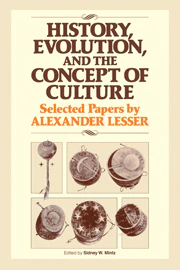
History, Evolution and the Concept of Culture
History, Evolution and the Concept of Culture
Alexander Lesser, one of Franz Boas's finest students, and probably one of the best of his time in his research on the Plains Indians, is a brilliant but neglected figure in American anthropology. This representative selection of Lesser's work is designed to make the range of his writings accessible to a broad audience. His work is of particular interest to present-day readers for its advocacy of an historical-evolutionary perspective in anthropology. Such an approach, almost unique at the time Lesser was writing, has become increasingly widely appreciated since. His work is also of interest for the light it throws on the British 'functionalist' school, and the effects of their views on American anthropology.
Product Information
Product Information
Shipping & Returns
Shipping & Returns
Description
Alexander Lesser, one of Franz Boas's finest students, and probably one of the best of his time in his research on the Plains Indians, is a brilliant but neglected figure in American anthropology. This representative selection of Lesser's work is designed to make the range of his writings accessible to a broad audience. His work is of particular interest to present-day readers for its advocacy of an historical-evolutionary perspective in anthropology. Such an approach, almost unique at the time Lesser was writing, has become increasingly widely appreciated since. His work is also of interest for the light it throws on the British 'functionalist' school, and the effects of their views on American anthropology.