From Synagogue to Church
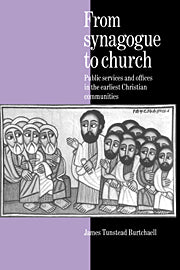
This important work challenges an entrenched scholarly consensus, that at the beginning it was inspired leaders - not ordained officers - who dominated the church. James Burtchaell illustrates that the traditional argument on behalf of clerical authority had read history backwards, and found the apostles to be the first bishops. In this study, Burtchaell reads history forwards, and demonstrates that first century Jews knew only one form of community organization, that of the synagogue. The three-level structure of offices in the synagogue - president, elders, and assistant - emerges, in the author's estimation, as the most plausible antecedent for the Christian offices which stand forth clearly in the second century. Burtchaell's conclusion is that ordained office is a foundational element in Christianity, but that, while the officers presided from the first, they rarely led. Thus, while Jesus' brother James presided as the ordained chief of the mother church in Jerusalem, it was Peter - Jesus' inspired veteran disciple - whose voice carried most authority. This revisionist historical account of Christian origins creatively subverts the established positions on church order, and thus opens up the arguments to new and larger conclusions.
Product Information
Product Information
Shipping & Returns
Shipping & Returns
From Synagogue to Church
From Synagogue to Church
This important work challenges an entrenched scholarly consensus, that at the beginning it was inspired leaders - not ordained officers - who dominated the church. James Burtchaell illustrates that the traditional argument on behalf of clerical authority had read history backwards, and found the apostles to be the first bishops. In this study, Burtchaell reads history forwards, and demonstrates that first century Jews knew only one form of community organization, that of the synagogue. The three-level structure of offices in the synagogue - president, elders, and assistant - emerges, in the author's estimation, as the most plausible antecedent for the Christian offices which stand forth clearly in the second century. Burtchaell's conclusion is that ordained office is a foundational element in Christianity, but that, while the officers presided from the first, they rarely led. Thus, while Jesus' brother James presided as the ordained chief of the mother church in Jerusalem, it was Peter - Jesus' inspired veteran disciple - whose voice carried most authority. This revisionist historical account of Christian origins creatively subverts the established positions on church order, and thus opens up the arguments to new and larger conclusions.
Original: $183.56
-70%$183.56
$55.07Product Information
Product Information
Shipping & Returns
Shipping & Returns
Description
This important work challenges an entrenched scholarly consensus, that at the beginning it was inspired leaders - not ordained officers - who dominated the church. James Burtchaell illustrates that the traditional argument on behalf of clerical authority had read history backwards, and found the apostles to be the first bishops. In this study, Burtchaell reads history forwards, and demonstrates that first century Jews knew only one form of community organization, that of the synagogue. The three-level structure of offices in the synagogue - president, elders, and assistant - emerges, in the author's estimation, as the most plausible antecedent for the Christian offices which stand forth clearly in the second century. Burtchaell's conclusion is that ordained office is a foundational element in Christianity, but that, while the officers presided from the first, they rarely led. Thus, while Jesus' brother James presided as the ordained chief of the mother church in Jerusalem, it was Peter - Jesus' inspired veteran disciple - whose voice carried most authority. This revisionist historical account of Christian origins creatively subverts the established positions on church order, and thus opens up the arguments to new and larger conclusions.