Foreign Policy and East Asia
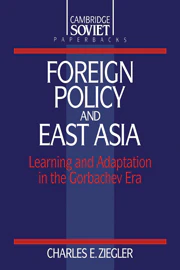
In this book Charles Ziegler develops the concept of learning in foreign policy by exploring the link between Mikhail Gorbachev's domestic reforms and the radical transformation of Soviet relations with North-east Asia in the 1980s. He argues that, although international factors may have played a role, it was pressures for domestic change, and economic reform in particular, which had the greatest impact on Soviet thinking. The history of Soviet relations with North-east Asia is briefly traced, highlighting the extent to which ideology impeded foreign policy learning under Stalin, Khrushchev and Brezhnev. The author then turns to Gorbachev's determined efforts to reverse thirty years of Sino–Soviet hostility, his mixed record on Soviet–Japanese relations, the turnaround in Soviet policy toward South Korea, and changing Soviet national security interests in the Far East and Western Pacific.
Product Information
Product Information
Shipping & Returns
Shipping & Returns
Foreign Policy and East Asia
Foreign Policy and East Asia
In this book Charles Ziegler develops the concept of learning in foreign policy by exploring the link between Mikhail Gorbachev's domestic reforms and the radical transformation of Soviet relations with North-east Asia in the 1980s. He argues that, although international factors may have played a role, it was pressures for domestic change, and economic reform in particular, which had the greatest impact on Soviet thinking. The history of Soviet relations with North-east Asia is briefly traced, highlighting the extent to which ideology impeded foreign policy learning under Stalin, Khrushchev and Brezhnev. The author then turns to Gorbachev's determined efforts to reverse thirty years of Sino–Soviet hostility, his mixed record on Soviet–Japanese relations, the turnaround in Soviet policy toward South Korea, and changing Soviet national security interests in the Far East and Western Pacific.
Original: $53.96
-70%$53.96
$16.19Product Information
Product Information
Shipping & Returns
Shipping & Returns
Description
In this book Charles Ziegler develops the concept of learning in foreign policy by exploring the link between Mikhail Gorbachev's domestic reforms and the radical transformation of Soviet relations with North-east Asia in the 1980s. He argues that, although international factors may have played a role, it was pressures for domestic change, and economic reform in particular, which had the greatest impact on Soviet thinking. The history of Soviet relations with North-east Asia is briefly traced, highlighting the extent to which ideology impeded foreign policy learning under Stalin, Khrushchev and Brezhnev. The author then turns to Gorbachev's determined efforts to reverse thirty years of Sino–Soviet hostility, his mixed record on Soviet–Japanese relations, the turnaround in Soviet policy toward South Korea, and changing Soviet national security interests in the Far East and Western Pacific.