Cross-Examinations of Law and Literature
In Cross Examinations of Law and Literature Brook Thomas uses legal thought and legal practice as a lens through which to read some of the important fictions of antebellum America. The lens reflects both ways, and we learn as much about the literature in the context of contemporary legal concerns as we do about the legal ideologies that the fiction subverts or reveals. Successive chapters deal with Cooper's Pioneers and Hawthorne's The House of Seven Gables (property law and the image of the judiciary), Melville's 'Benito Cereno' and Stowe's Uncle Tom's Cabin (slavery), Melville's White Jacket, Pierre and 'Bartleby' (worker exploitation or wage slavery), The Confidence-Man (contracts), and finally, 'Billy Budd', which examines a number of issues illustrative of the triumph of legal formalism after the Civil War.
Product Information
Product Information
Shipping & Returns
Shipping & Returns
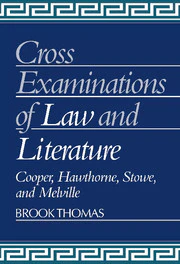
Cross-Examinations of Law and Literature
Cross-Examinations of Law and Literature
In Cross Examinations of Law and Literature Brook Thomas uses legal thought and legal practice as a lens through which to read some of the important fictions of antebellum America. The lens reflects both ways, and we learn as much about the literature in the context of contemporary legal concerns as we do about the legal ideologies that the fiction subverts or reveals. Successive chapters deal with Cooper's Pioneers and Hawthorne's The House of Seven Gables (property law and the image of the judiciary), Melville's 'Benito Cereno' and Stowe's Uncle Tom's Cabin (slavery), Melville's White Jacket, Pierre and 'Bartleby' (worker exploitation or wage slavery), The Confidence-Man (contracts), and finally, 'Billy Budd', which examines a number of issues illustrative of the triumph of legal formalism after the Civil War.
Original: $157.46
-70%$157.46
$47.24Product Information
Product Information
Shipping & Returns
Shipping & Returns
Description
In Cross Examinations of Law and Literature Brook Thomas uses legal thought and legal practice as a lens through which to read some of the important fictions of antebellum America. The lens reflects both ways, and we learn as much about the literature in the context of contemporary legal concerns as we do about the legal ideologies that the fiction subverts or reveals. Successive chapters deal with Cooper's Pioneers and Hawthorne's The House of Seven Gables (property law and the image of the judiciary), Melville's 'Benito Cereno' and Stowe's Uncle Tom's Cabin (slavery), Melville's White Jacket, Pierre and 'Bartleby' (worker exploitation or wage slavery), The Confidence-Man (contracts), and finally, 'Billy Budd', which examines a number of issues illustrative of the triumph of legal formalism after the Civil War.