Community, Liberalism and Christian Ethics
This book explores some issues on the borderland between moral philosophy and Christian theology. Particular attention is paid to the issues at stake between liberals and communitarians and the dispute between realists, non-realists and quasi-realists. In the course of the discussion the writings of Alasdair MacIntyre, George Lindbeck and Stanley Hauerwas are examined. While sympathetic to many of the typical features of post-liberalism, the argument is critical at selected points in seeking to defend realism and accommodate some aspects of liberalism. The position that emerges is more neo-Barthian than post-liberal. In maintaining the distinctiveness of Christian ethics and community, the book also seeks to acknowledge common moral ground held by those within and without the church.
Product Information
Product Information
Shipping & Returns
Shipping & Returns
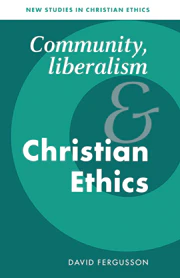
Community, Liberalism and Christian Ethics
Community, Liberalism and Christian Ethics
This book explores some issues on the borderland between moral philosophy and Christian theology. Particular attention is paid to the issues at stake between liberals and communitarians and the dispute between realists, non-realists and quasi-realists. In the course of the discussion the writings of Alasdair MacIntyre, George Lindbeck and Stanley Hauerwas are examined. While sympathetic to many of the typical features of post-liberalism, the argument is critical at selected points in seeking to defend realism and accommodate some aspects of liberalism. The position that emerges is more neo-Barthian than post-liberal. In maintaining the distinctiveness of Christian ethics and community, the book also seeks to acknowledge common moral ground held by those within and without the church.
Product Information
Product Information
Shipping & Returns
Shipping & Returns
Description
This book explores some issues on the borderland between moral philosophy and Christian theology. Particular attention is paid to the issues at stake between liberals and communitarians and the dispute between realists, non-realists and quasi-realists. In the course of the discussion the writings of Alasdair MacIntyre, George Lindbeck and Stanley Hauerwas are examined. While sympathetic to many of the typical features of post-liberalism, the argument is critical at selected points in seeking to defend realism and accommodate some aspects of liberalism. The position that emerges is more neo-Barthian than post-liberal. In maintaining the distinctiveness of Christian ethics and community, the book also seeks to acknowledge common moral ground held by those within and without the church.