Biological Complexity and Integrative Pluralism
This fine collection of essays by a leading philosopher of science presents a defence of integrative pluralism as the best description for the complexity of scientific inquiry today. The tendency of some scientists to unify science by reducing all theories to a few fundamental laws of the most basic particles that populate our universe is ill-suited to the biological sciences, which study multi-component, multi-level, evolved complex systems. This integrative pluralism is the most efficient way to understand the different and complex processes - historical and interactive - that generate biological phenomena. This book will be of interest to students and professionals in the philosophy of science.
Product Information
Product Information
Shipping & Returns
Shipping & Returns
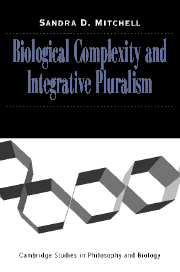
Biological Complexity and Integrative Pluralism
Biological Complexity and Integrative Pluralism
This fine collection of essays by a leading philosopher of science presents a defence of integrative pluralism as the best description for the complexity of scientific inquiry today. The tendency of some scientists to unify science by reducing all theories to a few fundamental laws of the most basic particles that populate our universe is ill-suited to the biological sciences, which study multi-component, multi-level, evolved complex systems. This integrative pluralism is the most efficient way to understand the different and complex processes - historical and interactive - that generate biological phenomena. This book will be of interest to students and professionals in the philosophy of science.
Original: $64.76
-70%$64.76
$19.43Product Information
Product Information
Shipping & Returns
Shipping & Returns
Description
This fine collection of essays by a leading philosopher of science presents a defence of integrative pluralism as the best description for the complexity of scientific inquiry today. The tendency of some scientists to unify science by reducing all theories to a few fundamental laws of the most basic particles that populate our universe is ill-suited to the biological sciences, which study multi-component, multi-level, evolved complex systems. This integrative pluralism is the most efficient way to understand the different and complex processes - historical and interactive - that generate biological phenomena. This book will be of interest to students and professionals in the philosophy of science.