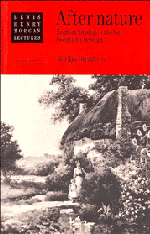
After Nature
Central as kinship has been to the development of British social anthropology, this is the first attempt by an anthropologist to situate ideas about English kinship in a cultural context. Based on the Morgan lectures given at the University of Rochester in 1989, After Nature challenges the traditional separation of western kinship studies from the study of society. Marilyn Strathern looks back at mid-century writings on kinship, both within anthropology and outside, and demonstrates continuities between middle-class folk models of kinship and anthropological kinship theory. She also shows how conceptualisations of change have enabled that past world to produce the present one. The values placed upon individual choice, as well as the vanishing of 'society' as a self-evident point of reference, are part of an evolving cultural explicitness about kinship and the naturalness of connections between persons. After Nature is a timely reflection at a moment when advances in reproductive technology raise questions about the natural basis of kinship relations.
Product Information
Product Information
Shipping & Returns
Shipping & Returns
After Nature
After Nature
Central as kinship has been to the development of British social anthropology, this is the first attempt by an anthropologist to situate ideas about English kinship in a cultural context. Based on the Morgan lectures given at the University of Rochester in 1989, After Nature challenges the traditional separation of western kinship studies from the study of society. Marilyn Strathern looks back at mid-century writings on kinship, both within anthropology and outside, and demonstrates continuities between middle-class folk models of kinship and anthropological kinship theory. She also shows how conceptualisations of change have enabled that past world to produce the present one. The values placed upon individual choice, as well as the vanishing of 'society' as a self-evident point of reference, are part of an evolving cultural explicitness about kinship and the naturalness of connections between persons. After Nature is a timely reflection at a moment when advances in reproductive technology raise questions about the natural basis of kinship relations.
Original: $44.96
-70%$44.96
$13.49Product Information
Product Information
Shipping & Returns
Shipping & Returns
Description
Central as kinship has been to the development of British social anthropology, this is the first attempt by an anthropologist to situate ideas about English kinship in a cultural context. Based on the Morgan lectures given at the University of Rochester in 1989, After Nature challenges the traditional separation of western kinship studies from the study of society. Marilyn Strathern looks back at mid-century writings on kinship, both within anthropology and outside, and demonstrates continuities between middle-class folk models of kinship and anthropological kinship theory. She also shows how conceptualisations of change have enabled that past world to produce the present one. The values placed upon individual choice, as well as the vanishing of 'society' as a self-evident point of reference, are part of an evolving cultural explicitness about kinship and the naturalness of connections between persons. After Nature is a timely reflection at a moment when advances in reproductive technology raise questions about the natural basis of kinship relations.